Take 15 seconds and complete my poll regarding Lincoln's property taxes... https://docs.google.com/forms/d/e/1FAIpQLSelWOuTNzfeFqeHp6ig9fk6xjLDGNGe6Tjh6oL1xqRMESU72A/viewform?usp=sharing&ouid=109206128981620997197

Too Much Wood: The Logging Industry Is Hurting.
Nicholas Askew
1/17/20262 min read

by Nicholas Askew
January 13, 2026
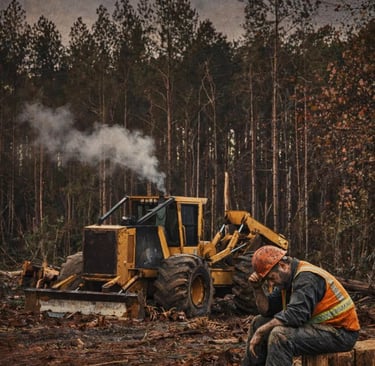
A lot of people see log trucks on the road and assume the logging industry must be doing fine. The truth is, logging right now is in one of the toughest spots many of us have ever seen. Long-time loggers with decades in the woods are saying this is the worst they have experienced.
Across Alabama and the surrounding states, the system is overloaded. Wood production has stayed high while demand has dropped. Quotas are tight, mills are full, and many good logging crews are struggling to stay afloat. To make it worse, several mills in neighboring states have closed, pushing even more loggers and wood into the same shrinking group of mills, increasing competition and driving prices down even further.
Logging is not an easy job. It’s long hours, early mornings and late evenings. It’s also one of the most dangerous industries in the country. Loggers and log truck drivers work around heavy equipment, unstable ground, falling timber, and public highways every day. One mistake can change a life forever.
This isn’t about poor management or bad crews. It’s about basic supply and demand no longer lining up. Even with fuel costs coming down some, it hasn’t been enough to offset equipment payments, insurance, maintenance, labor, and other operating expenses. Many operations are hanging on by a thread, and some are being forced to shut down entirely.
Here are a few of the major factors hitting the industry right now:
• Mills are slap full and quotas are extremely tight
• Mill closures in surrounding states have flooded remaining markets with excess wood
• Wood supply far exceeds demand across nearly every product
• Equipment financing approved too many new crews, increasing oversupply
• Equipment prices and monthly payments are at all-time highs
• Insurance, maintenance, labor, and operating costs remain high
• Modern crews rarely get shut down by weather, keeping production high even when demand is low
Logging supports sawmills, paper mills, truck drivers, mechanics, fuel suppliers, landowners, and entire rural communities. When logging hurts, the ripple effect is felt far beyond the woods.
This post isn’t about complaining. It’s about awareness. Logging is hard, dangerous work, done by people who put in long hours to keep raw materials moving for everyday products most people rely on.
If you see a logger or a log truck, understand there’s a lot more going on behind the scenes than most people realize.